When Should Mulch Go Down, and How Much Do You Need?
Spring timing, two to three inches deep, and why piling more every year does real damage. A straight answer on mulch depth and prep.
JC Landscaping Crew
·
Updated August 2026
·
7 min read
Knowing when to mulch in New Jersey is easier than knowing how much, and the second question is where most beds go wrong. Mulch does three useful things: it holds moisture in the soil, it suppresses weeds, and it moderates soil temperature through our swings between a warm March week and a hard freeze the following Tuesday.
It also looks finished, which is honestly why most people buy it. What it doesn’t do is improve a bed indefinitely if you keep adding more every spring without removing what’s already there.
Beds around New Jersey homes routinely carry five or six inches of accumulated mulch piled against shrub stems, and those shrubs are slowly rotting from the base while everyone admires the color. Here’s the timing, the depth, and the prep that actually matters.
01
Spring Is the Standard Window
Most New Jersey properties get mulched once a year, in spring, after the ground has warmed and the early weeds have been pulled. Going too early traps cold in the soil and delays everything you planted. Going too late means weeds have already germinated and you’re burying them rather than blocking them.
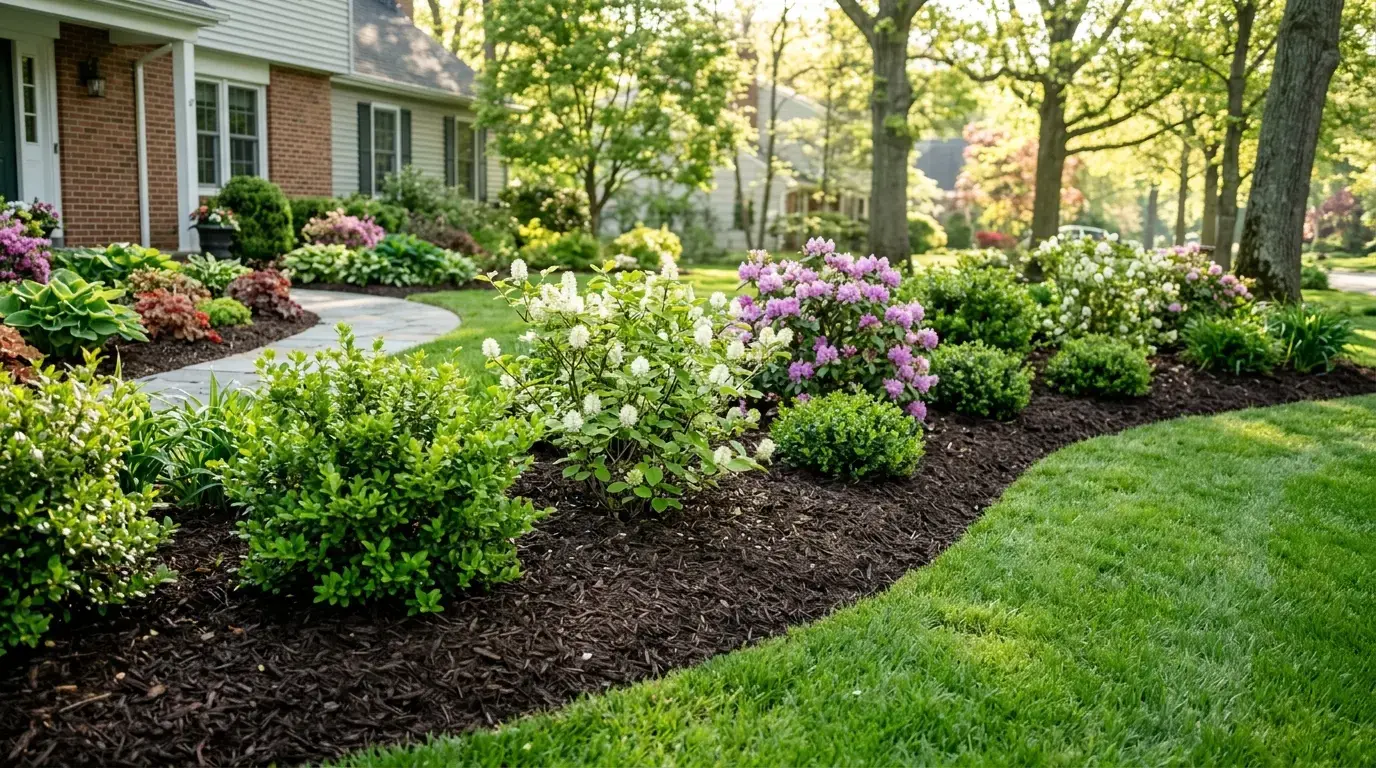
Spring mulching — after the last hard frost, before the first real heat.
A rough guide is after the last hard frost and before the first real heat, which in most of the state lands somewhere in April into early May. Fall mulching has a place, particularly for insulating newer plantings through their first winter, but it’s a supplement rather than a replacement. If you only do it once, do it in spring.
02
Two to Three Inches, Not More
Two to three inches is the target depth. That’s enough to block light from reaching weed seeds and enough to slow evaporation from the soil surface. Beyond three inches, mulch starts working against you.
Mulch piled in a cone against a tree trunk is the most common version of this — and it’s genuinely harmful, however normal it looks on suburban streets.
It sheds water rather than letting it through, so rain runs off instead of reaching roots. It holds moisture against stems and trunks, which invites rot and gives insects a place to work unseen. It can go anaerobic in the lower layers, which produces a sour smell and compounds that damage plants.
03
Prep Before the Mulch Goes Down
Mulch over a weedy bed gives you a mulched weedy bed. The order that works is pull the weeds first, then cut a clean edge, then mulch. The edge does more for appearance than the mulch color does, and it’s the thing that makes a bed read as maintained from the street.
Pull Weeds First
Mulching over weeds gives a mulched weedy bed. They come back.
Cut a Clean Edge
Does more for appearance than mulch color ever will.
Don’t Just Pile On
If last year is 3 inches, break it up, don’t add another 2.
If last year’s mulch is still three inches deep, don’t add another two on top. Break up any crust that’s formed, rake it out to redistribute it, and add only what’s needed to reach the target depth.
Every few years it’s worth removing accumulated material entirely, particularly in beds where the soil level has crept up against the foundation or the siding.
04
Mulch Types and What They Actually Do
Shredded hardwood is the common choice in New Jersey and it does the job well. It knits together, so it stays put on a slope better than nugget bark, and it breaks down over a season or two, which feeds the soil. Dyed mulch holds color longer and is fine, though the color fades regardless and it doesn’t change what the mulch does.
Shredded hardwood knits together and stays put on slopes.
Bark nuggets last longer but float and wash out in a hard rain. Stone doesn’t decompose, which sounds like an advantage until you need to change the bed layout or you realize it stores heat against your plants all August.
For most beds around a house, shredded hardwood at the right depth is the answer. Everything else is a specialty case.
Once a year for most New Jersey properties, and it’s usually a top up rather than a full replacement. Every few years, remove accumulated material rather than adding to it, especially where the depth has crept past three inches.
Can you put mulch over weeds?+
You can, and they’ll come back through. Established weeds with root systems push through mulch easily. Pull them first, and the mulch will handle the seeds that would have germinated after.
Is landscape fabric worth putting under mulch?+
In planting beds, usually not. It blocks the mulch from feeding the soil as it breaks down, and weeds eventually root in the mulch layer above it anyway. Under stone it makes more sense.
Does mulch attract termites?+
Mulch itself isn’t a food source they seek out, but deep mulch piled against a foundation creates the damp, hidden conditions insects like. Keep it back a few inches from the siding and at the right depth.
What’s the best time to mulch in New Jersey?+
Spring, after the last hard frost and after the early weeds have been pulled. That’s typically April into early May depending on the year and where in the state you are.
Free Estimate
Get your landscaping estimate in New Jersey
We handle mulch installation, bed edging, and cleanups on a schedule. Free estimates, no obligation.