The number matters less than how it’s compacted. What the base actually does, why lifts beat depth, and how clay or sandy soil changes the answer.
JC Landscaping Crew
·
Updated August 2026
·
8 min read
Paver patio base depth in New Jersey is the question that decides whether your patio is flat in fifteen years or wavy in five. It’s also the part of the job nobody photographs, which is why it’s the easiest place for a contractor to save money without the customer noticing until long after the check cleared.
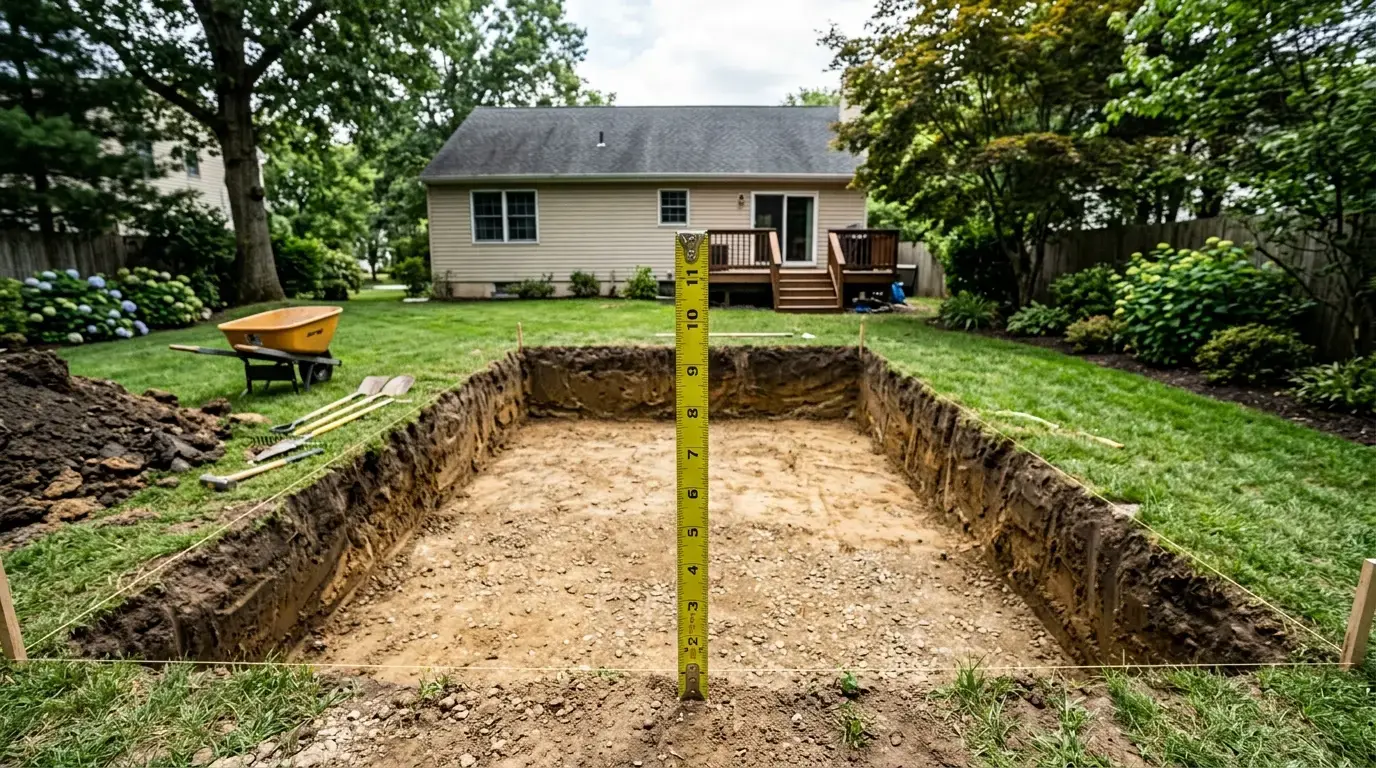
The short answer most of the trade works to is four to six inches of compacted stone for foot traffic, and more where a vehicle drives over it. But the number alone is misleading, because a six inch base dumped in one pass and rolled once performs worse than a four inch base compacted properly in layers.
What’s under the base matters too. Clay behaves differently from the sandy soil closer to the coast, and both change what the base has to do. Here’s how to think about it before you sign anything at all.
01
What the Base Actually Does
The stone base spreads load. When someone stands on a paver, that weight transfers through the joint sand to the pavers beside it, then down into the base, which distributes it across a wider area of soil than the paver alone would. A properly compacted base also stays put.
Angular crushed stone locks together mechanically when compacted.
The base also handles water. Rain that gets through the joints passes into the stone and moves out rather than sitting under the bedding layer. That’s the piece that matters most in New Jersey, because water sitting under a patio through a freeze cycle is what pushes pavers out of level.
02
Depth Depends on What Rolls Over It
A patio that only ever sees people and furniture asks much less of its base than a driveway apron that takes a car. That’s the reason the trade range runs four to six inches for pedestrian surfaces and goes deeper, often eight to twelve, for vehicle areas. Walkways sit at the lower end of the pedestrian range.
A walkway that crosses the end of a driveway needs the driveway base under it, not the walkway base — because a delivery truck doesn’t know where your walkway starts.
Where the two meet matters, and it’s a spot that gets built wrong often. Anywhere a vehicle might cross, even occasionally, should get built for the vehicle.
03
Compaction in Lifts Beats Total Depth
A plate compactor only densifies stone a few inches down. Put six inches in at once and run the compactor over it and you get a compacted top layer sitting on loose stone underneath. It feels solid when you walk on it and it settles for years.
One Pass
Compacted crust on loose stone. Feels solid, settles for years.
In Lifts
3–4 inches, compact, repeat. Done settling before pavers.
Subgrade First
Ground itself gets compacted before any stone goes in.
Building in lifts means placing three or four inches, compacting it, then placing the next layer and compacting again. It’s slower and it’s the difference between a base that’s finished settling before the pavers go down and one that settles under your furniture.
Ask any contractor how many passes and how many lifts. The answer tells you a lot.
04
Soil Under the Base Changes the Answer
Much of central New Jersey sits over Piedmont clay. Clay drains slowly and holds water, which means the base has to move water sideways to somewhere it can leave, and a geotextile between the subgrade and the stone keeps clay from pumping up into the base over time.
Geotextile fabric keeps clay from mixing with the base over time.
Closer to the coast the soil turns sandy. Sand drains beautifully, which removes most of the water problem, but it has almost no cohesion, so it shifts and the edge restraint carries more of the job.
Neither soil is bad. They just ask for different details, and a contractor who builds every patio in the state the same way is going to be right about half the time.
For pedestrian traffic on stable ground, it’s within the range most of the trade works to. Deeper is better on clay or where the subgrade is soft, and any area a vehicle might cross should be built well beyond it.
What kind of stone should be used?+
Angular crushed stone with fines, not round gravel. The angular pieces lock together when compacted, and the fines fill the gaps. Round stone stays loose no matter how many passes it gets.
Do I need geotextile fabric under the base?+
On clay it’s worth it. The fabric separates the subgrade from the stone so the two don’t mix over time. On clean sandy ground it matters less, though it doesn’t hurt.
How can I tell if my base was built right?+
You mostly can’t from the surface, which is the problem. What you can do is watch the job. Ask to see the excavation depth and the compactor running between lifts before the pavers go down.
Does base depth matter more in New Jersey than elsewhere?+
Freeze and thaw makes it matter more here than in a warm climate. Water trapped under a thin base expands every time it freezes, and that cycle repeats dozens of times a winter.
Free Estimate
Get your paver patio estimate in New Jersey
Ask us what base depth your project needs and why. Free estimates in writing, with no obligation.